
HISTORY
In the year 1795, Nicolas-Jacques Conté created a combination of clay and graphite in response to the lack of graphite created during the Napoleonic Wars. Since then, the French Company has gained a reputation with its pastels, pencils, markers and all kinds of art supplies and merging, at some point, with the BIC brand.
The products I have tried from Conté have been mainly individual pencils in white or sepia tones, and I am very satisfied with them. Those individual pastel pencils are, in fact, the best quality pastel pencils I have tried, both their pigments and the quality of their barrels.
The pencils I talk about in this review, however, didn’t leave me so satisfied: they are the old Conté Evolution, which I guess it’s a discontinued line, because I cannot find them anywhere anymore. Currently, the Conté official site only shows the professional pencil lines. Student degree pencils (like my set) cannot be found anywhere.
SPECIFICATIONS


The innovation in the case of the Conté Evolution pencils was that they were woodless, which was substituted by resin and other materials.
Conté Evolution pencils are solid but light, handy and hexagonal. Their barrels are painted on a colour that matches the lead. The tip of the barrel is open, and it allows us to see a well-centered lead. In the barrel of each pencil is engraved the word “Evolution” in golden letters followed by the number 93, which I presume is the series, the country of origin (France) and the brand name.
Since these pencils are student grade, there is no relevant technical information and, of course, there is no lightfast degree. On the cover of the tin they let us know that the pencils are respectful with the environment and that they are wood-free.
PERFORMANCE
Conté Evolution don’t smudge nor spread crumbs when colouring. They don’t have a scent and can be sharpened without problems.
So far so good. The problem comes when we try to colour: you can almost break your wrist and make a hole on the paper in the attempt, but the colour just won’t come out. They are very hard colours, and the tones are so pale that even you overlap several layers, you can’t still make it noticeable. Terrible, even for a child.
These colours cannot be blended, or they hardly do it. The selection of colours would be beautiful (pastel blue, salmon pink) if they could be successfully applied on the paper.
SET AND PACKAGING
This tin contains 12 pencils arranged by colour and pre-sharpened. It is a beautiful and light tin with hinges, but the plastic tray inside will not protect the pencils in case of an impact. However, since the pencils are syntetic, they appear to be sturdier than average.
COLOUR CHART
This is the colour chart for the 12 pencils set:
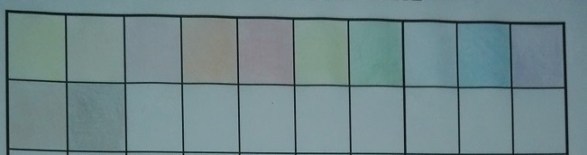
I think the paper waves can be appreciated in the image, which demonstrates how much pressure I had to apply for the colour to be noticeable. While it depends on the paper you use and a picture may be tricky because of the light, it doesn’t change the fact that these colours are practically imperceptible.
WHERE TO BUY
These pencils appear to be discontinued. The closest line would be BIC Conté, which is also woodless and inexpensive (the tin of 24 pencils costs around 8 pounds).
CONCLUSION
I don’t think it is an excuse that a pencil is cheap or student-grade to be so hard to work with. I have no idea if the current lines are better than this one, but I hope so.
PROS, CONS AND RATING
The best: the packaging.
The worst: they barely colour.
Rating: 2/10
MORE INFORMATION
 Learning to draw