
HISTORY
Derwent is an English company that dates back from 19th century, but it launched its first pencil in 1938. Particularly well known in the UK, this prestigious brand from Cumberland (where the valley where graphite was formerly discovered) manufactures not only pencils but also watercolours, pens and all sort of artistic material.
Derwent Inktense pencils are one of the most famous lines of the brand. Often they are confused with watercolours because they activate with water, but they are actually permanent soluble inks, which means the colours cannot be erased or modified (unlike watercolours) once they are dried. This makes them ideal to work in fabrics (specially silk and cotton) because the colours do not fade away with the washings. Derwent Inktense are also available in bars, which allows a total usage of their surface, and they act like dry chalks or previously wet with the paintbrush or dip in water. If you want to know more about the differences between Derwent watercolour pencils and Derwent Inktense pencils you can check the official site. I also recommend to visit my entry about the different Derwent pencil lines.
SPECIFICATIONS

The touch of the inktense pencil (unlike the watercolou version) is harder and waxier. The lead is also thicker, and so is the barrel. Inktense pencil is chunky and rounded. It is painted in blue and ends on a closed tip with a coloured matching the lead.
On one side of the barrel appears the manufacturing country, the name of the brand and the series along with the colour name and its number.
Only 7 of the 72 colours in the chart are classified with a moderated lightfastness. Most of the colours have higher degrees such as 6, 7 and 8, which are listed as “very good” and “excellent”.
PERFORMANCE
Inktense pencil is versatile and robust and it is halfway between a normal pencil and coloured ink. By itself, Inktense colour is pigmented, but after water is applied the colour becomes bright. It can spread some crumbs if the pencil is pressed too hard against the paper, but it doesn’t smudge. Inktense pencil is light and handy. It has some scent and can be sharpened without problem.
It is necessary to clarify that most colours in the chart have nothing to do with the dried tones once they are activated with water. For instance, we have “green leaf”, which almost look black, but once it is activated with water, a beautiful dark green shows up.
SETS AND PACKAGING
Inktense pencils are commercialized in tins of 12, 24, 36, 48 and 72 units. The 72 pencils set is also available in a wooden case. The beautifull tins don’t have hinges and will not protect the pencils in case of impact. The pencils are displayed on plastic trays inside the tins, they come pre-sharpened and arranged by colours.
COLOUR CHART AND DEMO
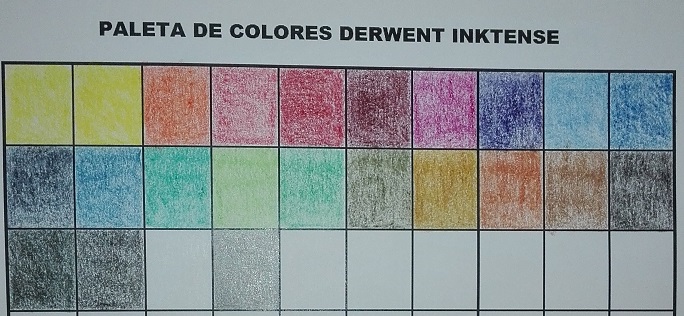
The colour chart for the 24 pencils set is this:
Sherbet lemon 0100 / Sun yellow 0200 / Mandarine 0300 / Poppy red 0400 / Chili red 0500 / Shiraz 0600 / Fuchsia 0700 / Violet 0800 / Iris blue 0900 / Bright blue 1000 / Indigo blue 1100 / Dark blue 1200 / Greenish blue 1300 / Apple green 1400 / Field green 1500 / Leaf green 1600 / Mustard 1700 / Baked earth 1800 / Willow 1900 / Bark 2000 / Coal grey 2100 / Ink black 2200 / Old white 2300 / Deliner 2400
In the colour chart the colours are dried but it can still be appreciated the pigments are vivid.
Here is a sample of the colours activated with water:

Here is an illustration where I used some Inktense pencils for the coat and the girl’s hair (source: Destiny Blue)

CONCLUSION
Inktense pencils are a solid and safe bet in the watercolour pencils field, because of their pigmented and bright shades. They also have a great lightfastness.
WHERE TO BUY
Inktense pencils can be purchased individually an they costa round 2 pounds per unit.
Inktense pencils can be bought in Amazon. The set of 24 is around 30 pounds.
All Derwent Inktense pencils in AMazon UK
PROS, CONS AND RATING
The best: solid pencils of vibrant permanent colours.
The worst: not enough pale tones.
Rate: 8/10
MORE INFORMATION
 Learning to draw